
 Available in GB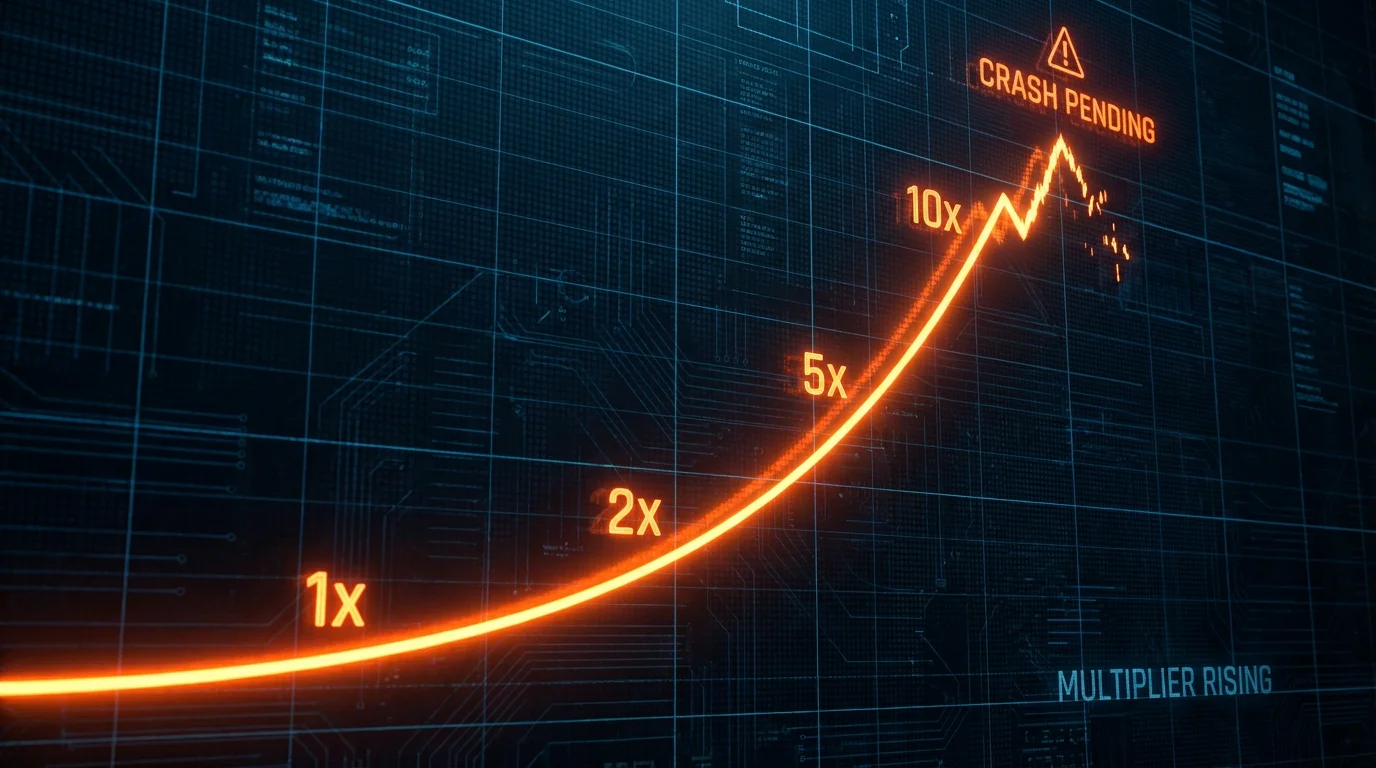
What Crash Games Are and Why They’re Everywhere
A multiplier rises. You cash out before it crashes. That’s the entire game. Crash games strip casino gambling to its most elemental form — a bet on timing against an unpredictable curve. There are no paylines, no dealer, no cards, and no spinning reels. You place a wager, watch a multiplier climb from 1.00x upward, and decide when to exit. If you cash out at 2.50x, your stake is multiplied by 2.5. If the game crashes before you cash out, you lose everything.
The format originated in the crypto gambling space around 2014 and has since migrated to mainstream online casinos, including the vast majority of non-GamStop sites. The appeal is easy to understand: rounds last seconds, the rules require no learning curve, and the tension of watching a multiplier tick upward creates immediate engagement. At UKGC-licensed casinos, crash games are available but subject to the same responsible gambling overlays — session timers, reality checks, mandatory cool-off intervals — that apply to all games. At non-GamStop casinos, those interruptions are absent. The game runs continuously, and the only limit on how fast you can play is how fast you can click.
That speed is both the genre’s selling point and its primary risk. A player can cycle through dozens of rounds in ten minutes, each one an independent bet with its own outcome. The rapid pace creates the illusion of pattern recognition — the feeling that you can predict when the next crash is coming — even though each round is mathematically independent of the last.
Popular Crash Games at Non-GamStop Sites
Aviator, JetX, Spaceman — the formats differ, the mechanic doesn’t. The crash game market has produced a handful of dominant titles that appear across nearly every non-GamStop casino lobby, each wrapping the same core mechanic in a different visual theme.
Aviator by Spribe is the category leader. Released in 2019, it popularised the crash format at traditional online casinos and remains the most widely available version across both regulated and offshore platforms. The visual is a small aeroplane climbing along a curve. The multiplier increases as the plane ascends. When the plane flies off the screen, the round ends. Aviator supports two simultaneous bets per round, allowing players to set different cashout targets — one conservative, one aggressive — within the same game.
JetX by SmartSoft Gaming uses a jet-powered spacecraft as its visual metaphor but operates on the same principle. Its distinguishing feature is a three-bet system rather than Aviator’s two, and its interface places more emphasis on multiplier history and statistical displays. Players who prefer a data-heavy screen while playing gravitate toward JetX.
Spaceman by Pragmatic Play brought the crash format to one of the industry’s largest providers. Pragmatic’s distribution network means Spaceman appears at more non-GamStop casinos than almost any other crash game. The astronaut theme is secondary to the provider’s reliability — Pragmatic’s game integrity and server infrastructure are well-established, and the provably fair verification that some crypto-native crash games offer is replaced here by the provider’s reputation and licensing.
Other entries include Cash or Crash by Evolution (a live-hosted variant that adds a human presenter and a slower pace), Plinko-style crash hybrids from various providers, and niche crypto-native titles like Bustabit and the original Crash game on BC.Game. The crypto-native versions often include provably fair verification, allowing players to independently confirm the fairness of each round’s crash point using cryptographic seeds. This feature is absent from the Pragmatic and Spribe versions, which rely on conventional random number generation audited by the provider.
Despite the variety in presentation, the core mechanic is identical across all titles. A random crash point is generated before the round begins. The multiplier climbs toward that point. Players who cash out before it are paid. Players who don’t lose their bet. The visual wrapper changes. The maths does not.
RTP, House Edge, and Volatility in Crash Games
Most crash games run a 97% RTP with extreme variance — the maths favours patience. The typical house edge for a crash game is 3%, meaning the casino retains an average of 3p from every pound wagered. This is comparable to European roulette (2.7%) and better than most video slots (3-5%). On paper, crash games are among the fairest casino products available.
The 97% RTP, however, masks the volatility profile that defines the player experience. Crash games can and do crash at 1.00x — meaning the round ends instantly and every player loses their bet. They can also reach multipliers of 100x, 1,000x, or higher before crashing, creating single-round payouts that dwarf anything a typical slot session produces. This extreme range of outcomes is the defining characteristic of the format.
The probability distribution of crash points follows a predictable mathematical curve. Approximately 1% of rounds crash at 1.00x (instant loss). Around 50% of rounds survive past 2.00x. Roughly 10% reach 10.00x. Fewer than 1% reach 100x or higher. These probabilities are built into the game’s algorithm and are consistent across all properly functioning crash games with a 97% RTP.
What this means in practice: a player who always cashes out at 2.00x will win approximately half of their rounds and lose the other half. The expected return on that strategy is close to the 97% RTP — you’ll slowly lose money at the rate of 3% of your total wagered. A player who always aims for 10.00x will win roughly one in ten rounds but receive a larger payout when they do. The expected return is the same: 97%. The variance changes dramatically between the two approaches, but the house edge remains constant.
This mathematical consistency is why crash games reward patience and discipline rather than aggression. Over hundreds of rounds, the house edge asserts itself regardless of strategy. The player’s only real choice is whether they experience that 3% cost as frequent small losses or infrequent large ones.
Can You Apply Strategy to Crash Games?
Strategies exist. None of them beat the house edge — they manage it. The most common crash game strategies are adapted from betting systems used in other forms of gambling, and they all share the same fundamental limitation: no strategy can overcome a negative expected value over time.
The fixed-cashout approach is the simplest. You set a target multiplier — say, 1.50x — and cash out at that point every round, regardless of how the multiplier is trending. This produces frequent small wins (you’ll win roughly two-thirds of rounds at 1.50x) and occasional full losses. The method is psychologically comfortable because it delivers regular positive feedback, but the maths remains the same: the 3% house edge applies to your total wagered.
The Martingale approach — doubling your bet after each loss to recover previous losses with a single win — is popular in crash game communities and dangerous for the same reasons it’s dangerous everywhere. It works until it doesn’t. A streak of early crashes can escalate your bet size beyond your bankroll or the casino’s maximum bet limit within a surprisingly small number of rounds. The system assumes infinite bankroll and no bet cap, neither of which exists in reality.
Anti-Martingale (increasing bets after wins and reducing after losses) and percentage-based bankroll systems offer better risk management than Martingale but still don’t alter the expected return. They change the shape of your results — smoother curves, smaller drawdowns — without changing the destination.
The auto-cashout feature available in most crash games allows you to set a target multiplier in advance, removing the emotional decision from each round. This is the closest thing to a genuine strategic advantage the format offers — not because it changes the maths, but because it prevents the impulse decisions that lead players to hold too long, chase losses, or deviate from their plan. Removing emotion from a game designed to exploit emotion is the most effective strategy available.
The Crash Always Comes
Every round ends at zero. The question is whether you left before it did. That’s the entire proposition of crash games, distilled to a single sentence. The game will always crash. The multiplier will always reach a point where it stops. Your only decision is when to leave.
Play crash games knowing the maths, knowing the house edge, and knowing that no strategy changes the long-term outcome. Set a session budget. Use the auto-cashout function. Walk away when the budget is spent. The format is designed to feel like a skill game. It isn’t. The entertainment value is real. The edge belongs to the house.